Product Knowledge
Outboard Motor CC vs Horsepower: Displacement, HP, and kW Explained
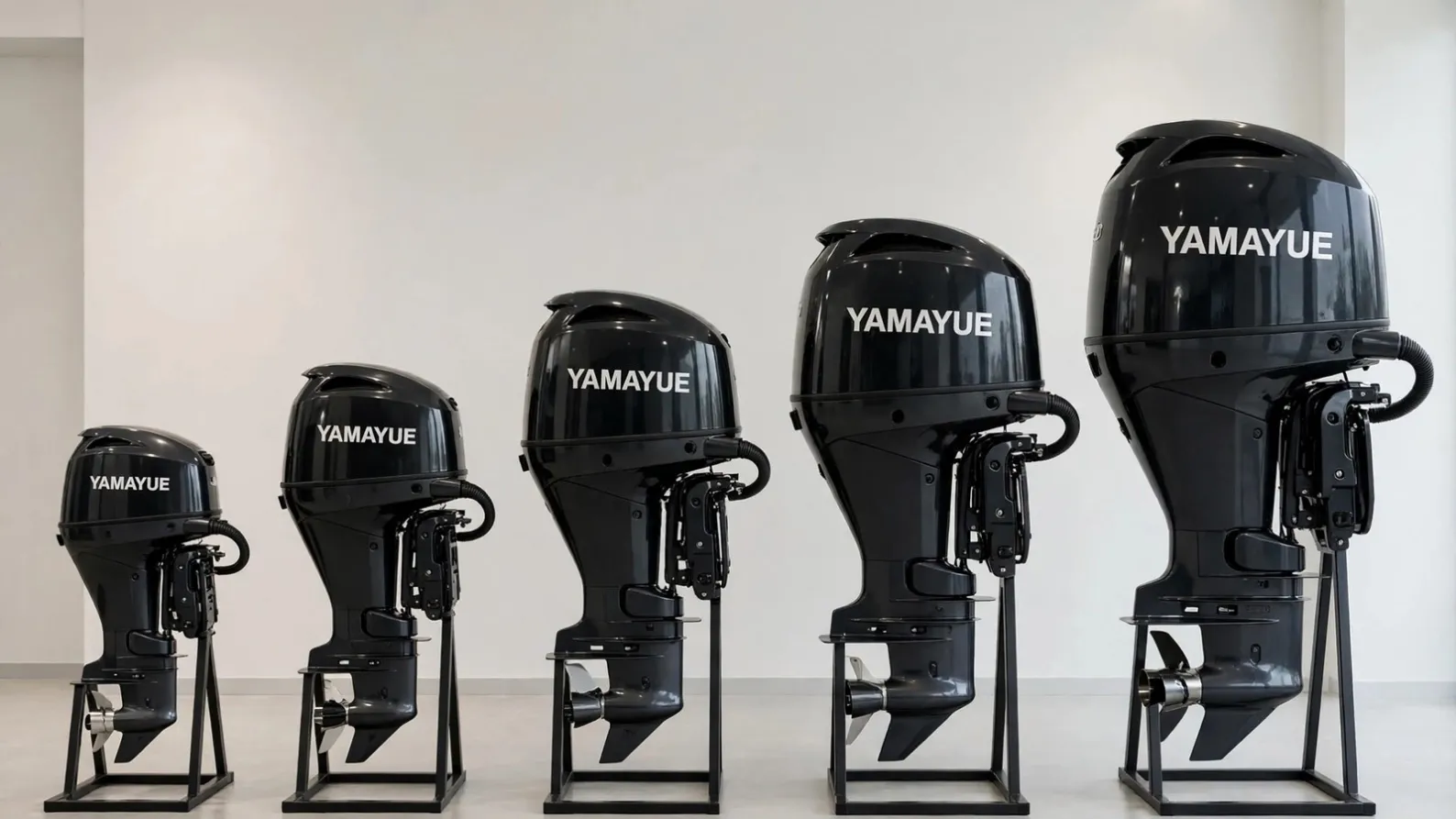
Outboard motor cc vs horsepower explained: what displacement means, how kW converts to HP, and why two motors with the same HP rating can feel different.
Every outboard specification table shows three numbers that buyers mix up: displacement in cc, rated output in kW, and a horsepower figure in the model name. They measure different things, and none of them alone tells you how a motor will feel on your boat. A 15HP 2-stroke and a 15HP 4-stroke share a model name but have different displacements, different weights, and different characters on the water. This guide explains what each number means, how to convert between kW and horsepower, and how to compare two motors on paper before you send an RFQ.
What does cc mean on an outboard motor?
Displacement, written as cc (cubic centimetres), is the total volume swept by all the pistons in the engine's cylinders. It is a measure of engine size, not of power. A cylinder with a wider bore or a longer stroke sweeps more volume, so it has a larger displacement. Add up all the cylinders and you have the engine's cc figure.
Displacement sets the ceiling for how much fuel and air mixture the engine can take in per cycle. A larger engine can burn more mixture per cycle than a smaller one, which is why displacement and output usually rise together. But displacement alone does not fix output. Two engines with the same displacement can produce different power if they breathe differently, run at different speeds, or use different working cycles — and that is exactly what happens between 2-stroke and 4-stroke designs, as the table below shows.
Displacement also says nothing about weight, shaft length, or start method, which are often the figures that decide a purchase. Use cc to understand the engine's size class. Use the rated output to compare power. Use the full specification table to compare everything else.
What do horsepower and kW measure?
Horsepower and kilowatts both measure power — the rate at which the engine does work. They are two units for the same thing, like inches and centimetres for length. Kilowatts are the metric unit used in most specification tables outside the United States. Horsepower is the traditional unit still used in model names and in everyday buyer language.
The conversion is fixed: 1 horsepower equals 0.746 kilowatts, so 1 kilowatt equals about 1.34 horsepower. To convert a kW rating to horsepower, divide the kW figure by 0.746. To convert horsepower to kW, multiply by 0.746. The results in this guide are rounded to one decimal place.
That conversion matters because model names are nominal — they label a power class, not an exact measured output. A motor named "15HP" is a 15-horsepower-class motor. Its rated output in kW is the precise figure, and converting that figure gives the measured horsepower equivalent, which may sit slightly above or below the name. When two motors carry the same model name, compare their kW ratings, not their names. The kW figure is the one the maker measured.
The YAMAYUE range: displacement and output side by side
The table below lists every YAMAYUE model with a verified displacement and rated output. Read it across the rows: at the same model name, the 4-stroke version always has the larger displacement, because a 4-stroke fires on every second revolution and needs more swept volume to match the 2-stroke's output.
Model | Displacement | Rated output |
|---|---|---|
6HP 2-stroke | 103cc | 4.4 kW |
6HP 4-stroke | 139cc | 4.4 kW |
8HP 2-stroke | 212cc | 5.9 kW |
9.9HP 2-stroke | 169cc | 7.3 kW |
9.9HP 4-stroke | 212cc | 7.3 kW |
15HP 2-stroke | 246cc | 11 kW |
15HP 4-stroke | 323cc | 11.0 kW |
20HP 4-stroke | 362cc | 14.7 kW |
25HP 2-stroke | 496cc | 18.4kW @ 5000 rpm |
25HP 4-stroke | 432cc | 25 HP @ 5500 rpm |
30HP 2-stroke | 496cc | 22.1 kW |
40HP 2-stroke | 703cc | 29.4 kW |
60HP 2-stroke | 849cc | 44.1 kW |
60HP 4-stroke | 996cc | 44.1 kW |
Three comparisons are worth noting. First, the 6HP models share the same 4.4 kW output, but the 4-stroke displaces 139cc against the 2-stroke's 103cc. Second, the 9.9HP models share 7.3 kW, yet the 2-stroke displaces only 169cc — less than the 8HP 2-stroke's 212cc — which shows that displacement does not rise in a straight line with the model name. Third, both 60HP models rate 44.1 kW, but the 4-stroke displaces 996cc against the 2-stroke's 849cc and weighs 154 kg against 106–108 kg. The range also includes a 25HP 2-stroke; its specification table is on its product page. For the full figures on any model, including shaft lengths and weights, check the specification table on the product page — and note that the 15HP 4-stroke figure above is the 323cc old-model displacement, not the current-generation figure used elsewhere in the market.
kW to horsepower conversion table
Use this table to translate the kW ratings in specification tables into the horsepower figures buyers use in conversation. Divide any kW figure by 0.746 to get its horsepower equivalent.
Rated output (kW) | Horsepower equivalent (rounded) | YAMAYUE models at this output |
|---|---|---|
4.4 kW | 5.9 hp | 6HP 2-stroke, 6HP 4-stroke |
5.9 kW | 7.9 hp | 8HP 2-stroke |
7.3 kW | 9.8 hp | 9.9HP 2-stroke, 9.9HP 4-stroke |
11 kW | 14.7 hp | 15HP 2-stroke, 15HP 4-stroke |
14.7 kW | 19.7 hp | 20HP 4-stroke |
22.1 kW | 29.6 hp | 30HP 2-stroke |
29.4 kW | 39.4 hp | 40HP 2-stroke |
44.1 kW | 59.1 hp | 60HP 2-stroke, 60HP 4-stroke |
The pattern to remember is that the measured equivalent sits just below the model name in most cases — 11 kW converts to about 14.7 hp on a motor sold as 15HP. That is normal. Model names are rounded class labels used across the industry, not laboratory measurements. What matters for comparing motors is that you compare the same unit: kW against kW, or converted horsepower against converted horsepower. Comparing one maker's model name with another maker's kW rating will mislead you.
Why the same HP rating can feel different on the water
If two motors share a kW rating, they make the same peak power. They do not necessarily feel the same, because power is only part of the story. Four other factors shape how a motor behaves on a boat.
First, the working cycle. A 2-stroke fires on every revolution, so it delivers its power in more frequent pulses and feels strong from a standing start. A 4-stroke fires on every second revolution and delivers its power more smoothly and quietly. Second, weight. The 60HP 2-stroke weighs 106–108 kg against 154 kg for the 60HP 4-stroke, and that weight difference changes how a small boat sits, accelerates, and handles. Third, gearing and propeller. The gear ratio in the lower unit and the propeller's pitch decide how engine power becomes thrust, and the wrong propeller can make a strong motor feel weak — see our gear ratio and propeller guide. Fourth, the boat itself. Hull shape, load, and water conditions decide how much of the motor's power becomes speed. A heavy load on a flat-bottomed work boat needs torque and grip more than top-end speed.
None of this means the kW rating is unimportant. It means the rating is the starting point, not the whole answer. Compare kW first to fix the power class, then compare weight, shaft length, start method, and gearing to choose inside the class.
How to compare two motors on paper
Work through the specification table in this order. First, match the kW rating to the power class you need — our sizing guide ties horsepower to boat length, and our selection guide covers horsepower, shaft length, and start method together. Second, compare displacement only within the same stroke type; across stroke types it does not predict output. Third, compare weight for the exact shaft and start version, because weight varies between versions and decides handling on small boats. Fourth, check the shaft length against your transom measurement — the shaft length guide shows how to measure. Finally, check the start method and control: manual start with a tiller handle on the small models, electric start and remote control options on the larger ones.
If two models look equal on paper, the difference is usually in the stroke type and what it means for your use. Our 2-stroke vs 4-stroke comparison and our how a 2-stroke works guide cover that choice in full.
Frequently asked questions
Q: Is a bigger cc always more powerful?
A: No. Displacement measures engine size, not power. The 15HP 2-stroke displaces 246cc and the 15HP 4-stroke displaces 323cc, yet both rate 11 kW. Compare the kW rating for power, and use cc only to understand the engine's size class.
Q: How do I convert kW to HP for an outboard motor?
A: Divide the kW figure by 0.746. For example, 11 kW divided by 0.746 is about 14.7 hp, and 44.1 kW is about 59.1 hp. Model names are rounded class labels, so the converted figure usually sits just below the model name.
Q: Why is the 15HP 4-stroke 323cc while the 15HP 2-stroke is 246cc?
A: Because the two engines work differently. A 4-stroke fires on every second revolution, so it needs more swept volume to produce the same output as a 2-stroke, which fires on every revolution. Both models rate 11 kW — the displacement difference reflects the working cycle, not a power difference.
Q: Does a higher kW motor always mean a faster boat?
A: No. Hull shape, load, gearing, propeller, and water conditions decide how much of the motor's power becomes speed. A higher kW motor on a heavy, overloaded hull can be slower than a smaller motor on a light, well-matched hull.
Q: What should I compare first — cc or kW?
A: kW, because it measures power. Use cc to understand engine size within one stroke type, then compare weight, shaft length, and start method for the exact version you need. Check the specification table on the product page for the full figures.
Request a wholesale quote
Tell us the horsepower and shaft length, the quantity, the destination country and port, and whether you need OEM branding or export packing, and we will reply with a quote. Browse the 2-stroke range and the 4-stroke range, or start from a model: 6HP 2-stroke, 15HP 2-stroke, 15HP 4-stroke, 20HP 4-stroke, 25HP 4-stroke, 60HP 4-stroke. See all models on the outboard motors hub.