Product Knowledge
Outboard Motor Gear Ratio and Propeller Selection Explained
Outboard motor gear ratio explained: what the ratio means, how propeller pitch changes speed and load, and how to match a propeller to your boat and load.
Two numbers decide how an outboard turns engine power into boat speed: the gear ratio in the lower unit and the pitch of the propeller. Get them right and the engine works in its comfortable range, the boat accelerates cleanly, and fuel use stays sensible. Get them wrong and the engine strains, the boat feels sluggish, or the engine over-revs with too little load. This guide explains both numbers in plain terms, shows how to read the symptoms of a wrong propeller, and tells you which figures to check before you order.
What does an outboard gear ratio mean?
The gear ratio is the reduction between the engine crankshaft and the propeller shaft, set by the gears in the lower unit. It is written as two numbers, for example 2.08:1. That means the crankshaft turns 2.08 times for every single turn of the propeller. The propeller always turns slower than the engine, and the gears multiply the turning force — torque — on the way.
Why reduce the speed at all? A small petrol engine makes its power at high revolutions, but a propeller works best turning much more slowly, pushing a large volume of water with each turn. The gears bridge that gap. A lower unit with a bigger reduction turns the propeller more slowly and with more torque, which suits heavy boats and heavy loads. A smaller reduction lets the propeller spin faster, which suits light boats that need speed.
The ratio is fixed for a given model — it is built into the lower unit and cannot be adjusted by the owner. The 9.9HP 4-stroke YAMAYUE supplies, for example, has a gear ratio of 2.08. For other models, the ratio is listed in the specification table on the product page and in the owner's manual. Always check the figure for your exact model rather than assuming one model's ratio applies to another.
How the lower unit turns engine speed into thrust
Power travels from the engine down a vertical driveshaft inside the leg to the lower unit, where a pair of gears turns the drive through 90 degrees to the horizontal propeller shaft. A shift mechanism selects forward, neutral, and reverse. In reverse, the gears drive the propeller shaft the other way.
The lower unit also holds the gear oil and the water pump. The pump sits above the gearcase and is driven off the driveshaft, so it turns whenever the engine runs. That is why an outboard must never run without a water supply — the pump impeller is turning from the first revolution, and running dry damages it in a very short time. Our guide to the water pump impeller and cooling system explains the cooling side in full.
Because the gears, the pump, and the propeller shaft all live in the lower unit, a knock or grounding that damages the propeller can also affect the gears and seals. After any strike, check the propeller for bent blades and the gear oil for water contamination, and have the lower unit inspected if the strike was hard. The routine is covered in our outboard motor maintenance guide.
Propeller pitch: the number that sets speed
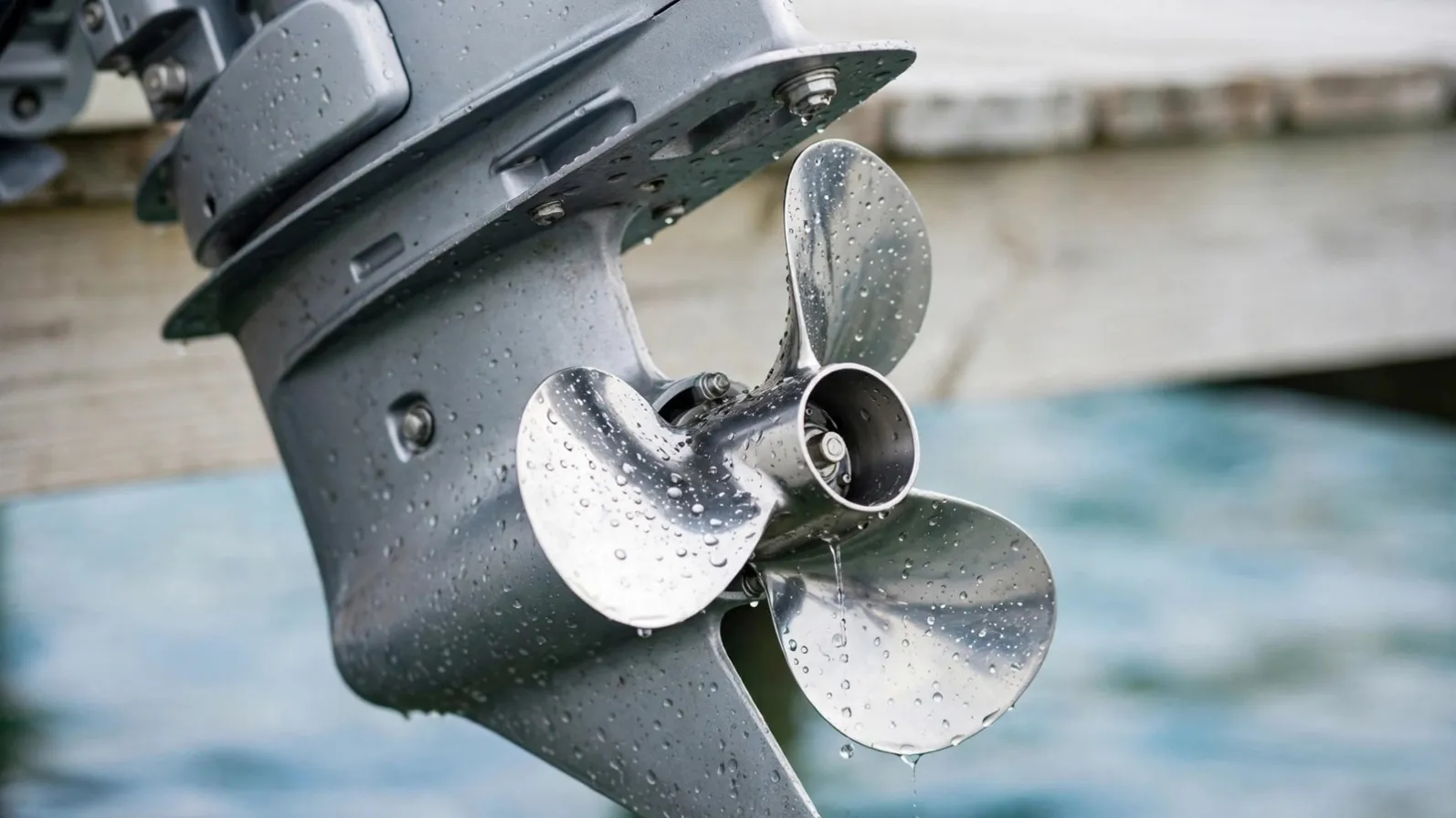
Propeller pitch is the distance the propeller would move forward in one full turn if it were screwing through a solid material — like the thread of a screw. A propeller with a higher pitch moves further per turn, so at the same propeller speed it pushes the boat faster. But it also loads the engine more, because each turn has to move more water. A lower pitch moves less far per turn, loads the engine less, and lets it rev more freely.
Change | Top speed | Acceleration | Engine load | Full-throttle revs |
|---|---|---|---|---|
Pitch higher | Higher, if the engine can still reach its range | Slower | Higher | Lower |
Pitch lower | Lower | Faster | Lower | Higher |
Pitch unchanged, diameter larger | Slightly lower | Slightly better grip | Higher | Lower |
Pitch unchanged, diameter smaller | Slightly higher | Less grip | Lower | Higher |
The table shows the trade-off every propeller choice makes. There is no pitch that is best for everything. A high pitch suits a light boat running at speed on open water. A low pitch suits a heavy boat, a boat that carries big loads, or a boat that needs strong acceleration from a standstill — a fishing boat pulling nets, for example, or a work boat pushing a loaded hull. Most owners need the pitch that lets the engine reach the full-throttle rev range printed in the owner's manual with the boat loaded as it is normally used. If the engine cannot reach that range, the propeller is too big. If it revs past the range with ease, the propeller is too small.
Diameter, blade count, and blade shape
Pitch is the headline number, but three other features shape how a propeller behaves. Diameter is the width of the circle the blade tips sweep. A larger diameter moves more water per turn and grips better at low speed, which helps heavy boats. A smaller diameter slips less at high speed, which helps fast, light boats. Diameter and pitch are chosen together — changing one usually means re-checking the other.
Blade count is usually three on small and mid-size outboards. Three blades give a good balance of speed and grip for most uses. Four blades grip harder and hold speed better in turns and in rough water, and they suit heavy loads, but they add drag and usually cost a little top speed. Blade shape matters too: cupped blades — blades with a small curve at the trailing edge — grip the water better and reduce slip, which helps when the motor is mounted high or the boat runs in choppy water.
None of these features can be judged from a single number. A propeller is a matched set: diameter, pitch, blade count, and shape together, made for a particular shaft and hub. When you change propellers, match the hub and spline to your motor's propeller shaft, and check the owner's manual for the propeller sizes approved for your model. A propeller from another horsepower class may look the same and still be wrong for the engine.
Reading the symptoms: is your propeller right?
The boat tells you when the propeller is wrong. Work through the symptoms below with the boat loaded as it is normally used, on calm water, and compare what you find with the full-throttle rev range in the owner's manual.
Symptom | Likely cause | What to check first |
|---|---|---|
Engine will not reach its full-throttle rev range | Pitch too high, or diameter too large | Try a lower pitch; check for a fouled hull or excess load |
Engine over-revs easily and feels loose | Pitch too low, or diameter too small | Try a higher pitch; check for a damaged or worn propeller |
Slow to get on the plane with a load | Too little grip or too high a pitch | Try a lower pitch or a larger diameter; check blade condition |
Propeller slips and the engine races in turns | Ventilation — air drawn in from the surface | Check mounting height and trim; check for blade damage |
Vibration at speed | Bent blade, damaged hub, or fishing line behind the hub | Remove the propeller and inspect it and the shaft |
Ventilation deserves a note of its own. It happens when air from the surface is drawn down into the propeller, usually in tight turns, in rough water, or when the motor is mounted too high. The propeller loses grip, the engine races, and the boat slows. It is not the same as cavitation, which is the formation of vapour bubbles on the blade surface at high load. Both feel like slipping, but ventilation is fixed by mounting height, trim, and blade condition, while persistent cavitation usually means the propeller size or shape is wrong for the load. If the symptoms do not clear after the checks above, ask a dealer to look at the combination of motor, mounting, and propeller together.
Gear ratio and propeller data on YAMAYUE models
Only one gear ratio figure is published in this guide, because it is the only one verified here: the 9.9HP 4-stroke has a gear ratio of 2.08, with a 212cc two-cylinder engine producing 7.3 kW and a short shaft of 431 mm or a long shaft of 558 mm. For every other model, the gear ratio, the approved propeller sizes, and the full-throttle rev range are in the specification table on the product page and in the owner's manual. Do not assume that a ratio or a propeller size from one model fits another, even at the same horsepower — the 9.9HP 2-stroke and the 9.9HP 4-stroke, for example, are different engines with different displacements and weights.
When you send an RFQ, include the boat type and length, the normal load, and how the boat is used — fishing, transport, patrol, or leisure. That lets us recommend a horsepower, a shaft length, and a propeller direction for the combination, rather than a motor on its own. Shaft length matters here too: the right shaft puts the propeller at the right depth, and the wrong shaft causes ventilation and poor grip whatever propeller you fit. Measure the transom as described in our shaft length guide, and match horsepower to boat length with our sizing guide.
Frequently asked questions
Q: What is a good gear ratio for an outboard motor?
A: There is no single best ratio. The ratio is matched to the engine's power and the propeller sizes the model is designed to turn. Compare ratios only between motors of the same class, and check the figure for your exact model in the specification table on the product page or the owner's manual.
Q: Does a higher pitch propeller make the boat faster?
A: Only if the engine can still reach its full-throttle rev range with the higher pitch. If the pitch is too high, the engine labours, revs stay low, and the boat is actually slower and uses more fuel. Top speed comes from the pitch the engine can turn at full throttle, not from the highest pitch available.
Q: Can I fit any propeller to my outboard motor?
A: No. The hub and spline must match your motor's propeller shaft, and the diameter and pitch must be approved for your model. Check the owner's manual for the approved sizes, and confirm the fit before you buy. A propeller from another horsepower class may look identical and still be wrong.
Q: How do I know if my propeller is the wrong size?
A: Compare full-throttle revs with the range in the owner's manual, with the boat loaded as normal. Revs below the range point to too much pitch or diameter; revs above the range point to too little. Sluggish acceleration, ventilation in turns, and vibration are the other warning signs.
Q: Does gear ratio affect fuel use?
A: Indirectly, through the propeller. The ratio itself is fixed, but a wrong propeller loads the engine outside its efficient range and the engine burns more fuel for the same trip. The right propeller lets the engine work in its efficient range, which keeps fuel use sensible.
Request a wholesale quote
Tell us the horsepower and shaft length, the quantity, the destination country and port, and whether you need OEM branding or export packing, and we will reply with a quote. Include the boat type, length, and normal load so we can recommend the right combination. Browse the 2-stroke range and the 4-stroke range, or start from a model: 9.9HP 4-stroke, 15HP 2-stroke, 20HP 4-stroke, 25HP 4-stroke, 60HP 4-stroke. See all models on the outboard motors hub.